How it works
Review each topic the day after you first study it. After that, double the gap each time (1, 2, 4, 8 days), but never let one gap grow beyond a share of the time until your exam: a quarter if the exam is up to two weeks away, a fifth up to six weeks, less for exams further out. Always do a final review the day before the exam.
Example schedules
The day you first study a topic is day 0. These are the review days the calculator gives for one topic, depending on how far away the exam is:
| Exam in | Longest gap | Review on day | Reviews |
|---|---|---|---|
| 1 week | 2 days | 1, 3, 6 | 3 |
| 2 weeks | 4 days | 1, 3, 7, 11, 13 | 5 |
| 1 month (30 days) | 6 days | 1, 3, 7, 13, 19, 25, 29 | 7 |
| 2 months (60 days) | 9 days | 1, 3, 7, 15, 24, 33, 42, 51, 59 | 9 |
| 3 months (90 days) | 14 days | 1, 3, 7, 15, 29, 43, 57, 71, 85, 89 | 10 |
Each review is short: ten to fifteen minutes of quizzing yourself on the topic from memory, not a full reread. Ten reviews over three months sounds like a lot, but it adds up to far less time than relearning the material the week before the exam.
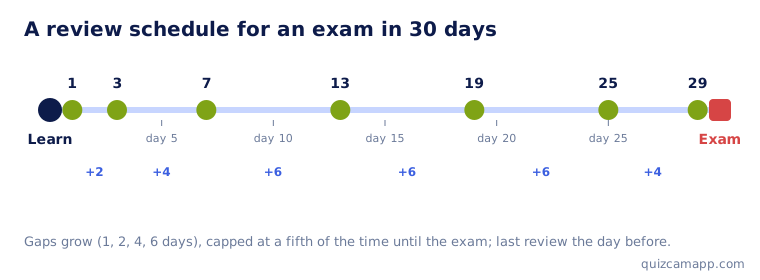
Use this chart
Free to use with a link back. Embed code:
Why the gaps grow
Every successful review makes a memory fade more slowly, so the next review can wait longer. That is the core of spaced repetition: each review should come shortly before you would have forgotten the material, which is a little later every time.
The limit on the gap comes from research on the best spacing for a given test date. In a large study with more than 1,300 participants, Cepeda and colleagues (2008) found that the ideal gap between study sessions depends on how long you need to remember. For a test one week away it was roughly 20 to 40 percent of that week. For a test a year away it was only about 5 to 10 percent of the year. Gaps that are too long cost more than gaps that are a little too short, so the calculator stays on the safe side.
Three rules the calculator cannot enforce for you
1. Review by recalling, not by rereading
A review only counts if you try to produce the answer before you look. Rereading feels productive because the page looks familiar, but recognizing is not remembering. Quiz yourself: close the notes, answer questions, then check. See active recall and retrieval practice.
2. If you blank, restart the topic
Spacing only pays off when the recall succeeds. If you cannot remember a topic at a review, it goes back to a short gap. Use the button under the topic to restart its schedule from today.
3. Mix topics in one session
On days with several reviews, switch between the topics instead of finishing one before starting the next. Interleaving feels harder and works better, especially for exams that mix question types.
Frequently asked questions
How many times should I review before an exam?
With one week, three reviews are enough. With a month, about seven short reviews per topic. With a whole semester, more reviews but with wider gaps. The table above shows the exact days.
My exam is tomorrow. Is spacing still possible?
Not really: spacing needs at least a couple of days. With one night left, quiz yourself tonight, sleep, and do one more short quiz in the morning. Retrieval still helps when spacing is no longer possible. The comparison of cramming vs. spacing explains the trade-off.
Is the calculator free, and is my data stored?
It is free and runs entirely in your browser. Nothing is sent to a server. Your plan is kept only in the page address, which is why the shareable link opens the same plan.
Can I link to this calculator?
Yes, please do. Study skills pages, course sites and tutors are welcome to link to it or share it with students.
Something to review with
Quizcam turns a photo of your notes into a quiz, then brings back the questions you got wrong on a spaced schedule, counted backwards from your exam date. Reviewing is free with no limit.
Try Quizcam free