Definition
The testing effect is the research finding that taking a test on material produces better long-term retention than spending the same amount of time studying that material again. It holds even when you answer wrongly and even when nobody tells you the right answer afterward, because the act of retrieval is what does the work.
It is the evidence behind active recall and retrieval practice, which are the names for the technique rather than the finding. A test, in this sense, is any attempt to produce an answer from memory: a quiz, a past paper, or a blank page.
What the testing effect is
When you take a test on something you've studied, you remember it better afterward. That's true even if you get some answers wrong. It's true even if you don't get any feedback on your answers. The simple act of trying to pull information from memory strengthens that memory in a way that re-reading the same information doesn't.
This isn't intuitive at all. Most students assume that studying means putting information into your brain, and that the more time you spend reading, the more you'll remember. Tests feel like they're measuring what you know, not building it. But decades of cognitive science research tell a different story. Testing isn't just an assessment tool. It's a learning tool. In many cases, it's the best learning tool available.
The testing effect applies to all kinds of tests: multiple choice, short answer, essay questions, even just trying to recall information without any formal test structure. What matters is the act of retrieval. When your brain searches for an answer, it strengthens the connection to that piece of information regardless of whether you find it or not.
The research behind it
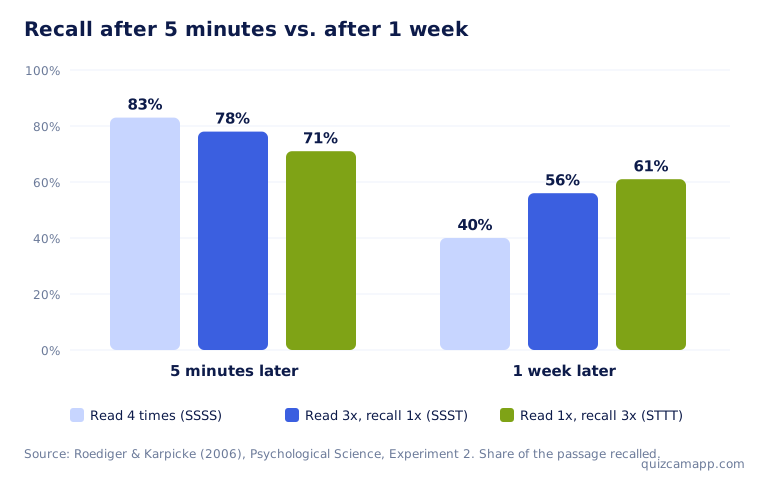
The landmark study on the testing effect was published by Henry Roediger and Jeffrey Karpicke in 2006. The setup was straightforward: students read a short prose passage about a scientific topic. One group then re-read the passage three more times. The other group read it once and took three free-recall tests where they wrote down everything they could remember.
Five minutes later, the re-readers did better on a final test (83% against 71%). But here's where it gets interesting: when the researchers tested both groups a full week later, the results flipped. The testing group still remembered 61% of the material. The re-reading group? Just 40%. The re-readers had forgotten more than half of what they knew five minutes after studying, the testing group only about a seventh.
Use this chart
Free to use with a link back. Embed code:
This wasn't a one-off result. The testing effect has been replicated hundreds of times. A 2011 review by Roediger and Butler looked at studies spanning different subjects (history, science, vocabulary, medical education), different age groups (elementary students through adults), and different test formats. The effect showed up consistently everywhere they looked.
One particularly striking study by McDaniel, Anderson, Derbish, and Morrisette (2007) tested the effect in an actual college course, not a lab. Students in a brain-and-behavior class who took short quizzes on the reading material did better on the unit exams for the quizzed material than for material they had only read, in a real course with real grades.
Even getting questions wrong helps. Kornell, Hays, and Bjork (2009) found that taking a test and getting the wrong answer, then seeing the correct answer, produced better retention than just studying the correct answer in the first place. The failed retrieval attempt primes your brain to encode the right answer more deeply when you eventually see it.
Why testing works better than re-reading
When you re-read your notes, something sneaky happens in your brain. The information looks familiar. You see the words and you think "yeah, I know this." That feeling of familiarity is comfortable, and it tricks you into believing you've learned the material. Psychologists call this the fluency illusion.
But familiarity and recall are completely different things. Recognizing information when you see it is easy. Producing that same information from scratch, which is what an exam requires, is hard. And here's the problem: re-reading only practices recognition. It never forces you to produce anything.
Testing forces production. When you face a question, your brain has to search through memory, locate the relevant information, organize it, and produce an answer. That whole process strengthens the memory in ways that passive reading can't touch. It's like the difference between watching someone ride a bicycle and actually getting on one yourself. Watching feels like learning, but it won't keep you upright.
There's another reason testing works so well: it tells you what you don't know. When you re-read everything, you treat all the material equally. When you test yourself, you quickly find out which parts are solid and which parts have gaps. This lets you focus your remaining study time on the weak spots instead of wasting it on material you already know.
How to use the testing effect
The simplest change you can make to your study routine is this: stop re-reading your notes. Instead, close them and try to recall what's on them. You can do this right now, today, without buying anything or changing your schedule. Just close the book and ask yourself "what did I just read?"
Here are specific ways to build testing into your study sessions:
- Cover and recall. After reading a section of your textbook, cover the page. Write down the main points from memory. Then uncover and check yourself. This takes about two minutes and it's dramatically more effective than reading the section a second time.
- Practice problems first. Before reviewing a chapter, try the practice problems at the end. You'll get most of them wrong if you haven't studied yet. That's fine. The struggle to answer them will make the subsequent reading much more effective because your brain is now primed to pay attention to those specific gaps.
- Quiz yourself on old material. Don't just test yourself on what you learned today. Pull out notes from last week's lecture and try to recall the key concepts. Older material benefits the most from testing because it's had time to start fading.
- Use multiple-choice questions. If free recall feels too hard, multiple-choice questions are a good starting point. They still produce the testing effect, and they give you retrieval cues that can help jog your memory. As you get more comfortable, move toward questions that require you to produce answers from scratch.
There is also a social version that costs nothing and works surprisingly well: quiz each other. When a study group swaps questions instead of re-reading slides together, everyone in the room is retrieving rather than listening. Writing the questions is itself useful, because you have to decide what the examinable claims in a chapter are. In Quizcam this is a duel: one tap turns a quiz into a link, whoever you send it to plays the same questions in their browser with no app and no account, and you land on a shared leaderboard.
The testing effect works best when you space out your tests over time. Testing yourself once is good. Testing yourself again three days later is better. And testing yourself a week after that is better still. When you combine spaced repetition with the testing effect, you get a study method that's hard to beat. Mixing subjects inside a single test, which is interleaving, adds a little more.
Put the testing effect to work
Quizcam writes multiple-choice questions from your own notes, slides or PDFs, explains every answer in a sentence or two, and brings the questions back on a daily review before your exam. Send a quiz as a link and your study group plays the same round in the browser, no app and no account needed. Three quizzes a month are free and reviewing the ones you already made stays free.
Try Quizcam freeOr play five sample questions in your browser first, no app needed.
Frequently asked questions
What is the testing effect?
The testing effect is the finding that retrieving information from memory, by testing yourself, improves long-term retention more than re-reading the same material. The act of recall itself strengthens memory.
How strong is the evidence for the testing effect?
It is very well established. In a classic 2006 study by Roediger and Karpicke, students who practiced recalling a passage remembered 61% of it a week later, versus 40% for students who re-read it. A 2014 meta-analysis by Rowland confirmed the effect across materials and test formats.
How do I use the testing effect when studying?
Replace some of your re-reading time with self-testing. Use practice questions, close your notes and write what you remember, or quiz yourself with flashcards. The goal is to attempt retrieval before checking the answer.
Does the testing effect work even if I get answers wrong?
Yes. As long as you check the correct answer afterward, attempting retrieval, even unsuccessfully, improves later memory more than not testing at all. Mistakes also show you exactly where to focus.
Is the testing effect the same as retrieval practice?
Almost. Retrieval practice is the technique of recalling material on purpose; the testing effect is the experimental finding that the technique improves retention. Papers often use the terms for each other, and nothing important hangs on the distinction.
Can I get the testing effect by quizzing with friends?
Yes, and it is one of the cheapest ways to get it. Whoever answers a question is retrieving, and whoever writes one has to decide what the examinable claims are. Quizcam turns any quiz into a link your study group can play in the browser, with a shared leaderboard and a rematch option.