Definition
Spaced repetition is a study method in which you review the same material several times at growing intervals, for example after one day, then three days, then a week, instead of studying it all in one sitting. Each review lands shortly before you would have forgotten the material, and every review makes the next forgetting slower.
It answers the question of when to study. Active recall answers how. Used together, they are the best-supported study combination in cognitive psychology: quiz yourself, on a schedule.
The forgetting curve
In 1885, a German psychologist named Hermann Ebbinghaus ran experiments on himself to figure out how memory works. He memorized lists of nonsense syllables and tracked how quickly he forgot them. What he found was depressing but useful: forgetting is steepest right after learning. A day later, relearning a list took him about two thirds of the original effort, and most of that loss happened in the first hour.
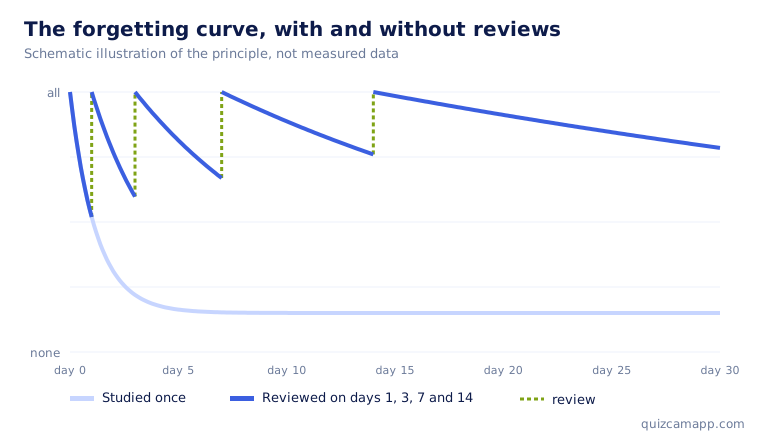
He called this the forgetting curve. It's a steep drop. You sit through a one-hour lecture, and by tomorrow morning, most of what you heard is gone. By next week, you're left with fragments. This isn't a flaw in your brain. It's just how memory works. Your brain constantly decides what to keep and what to discard, and if you don't signal that something matters, it gets tossed.
Use this chart
Free to use with a link back. Embed code:
Spaced repetition fights the forgetting curve by timing your reviews right before you're about to forget. The first review might come after one day. The next after three days. Then a week. Then two weeks. Each time you review the material, the forgetting curve gets shallower. The memory lasts longer before it starts to fade. After enough spaced reviews, the information moves into long-term memory and stays there for months or years.
The trick is that you don't need to review everything constantly. You just need to review at the right time. Too soon and you're wasting time on material you still remember. Too late and you've already forgotten it and need to relearn from scratch. Spaced repetition hits the sweet spot in between.
Why spacing beats cramming
Everybody knows someone who crams the night before an exam and passes. Maybe you've done it yourself. So why bother spacing things out?
Because cramming works for about 24 hours and then falls apart. You can hold a bunch of information in short-term memory long enough to dump it onto an exam paper, but a week later most of it is gone. If you're studying for a final that covers the whole semester, or for a professional certification you'll need to remember for years, cramming is useless.
A 2006 review by Cepeda, Pashler, Vul, Wixted, and Rohrer pooled 317 experiments from 184 articles. They found a clear pattern: spreading study sessions over time produced better retention than concentrating the same total study time into a single block, and the advantage grew the longer the delay before the test.
Here's what makes this finding so useful: the total study time was the same. Spacing doesn't mean studying more. It means distributing the same hours differently. Four one-hour sessions over two weeks beats one four-hour session the night before, even though you're spending the same amount of time.
The reason has to do with how memory consolidation works. When you sleep after a study session, your brain processes and strengthens the memories from that day. If you cram everything into one session, you only get one round of consolidation. If you spread it across four sessions, you get four rounds. Each sleep cycle between sessions gives your brain another chance to solidify the material.
How to space your studying
You don't need a complicated algorithm to use spaced repetition. A rough schedule works just fine. Here's a simple one that works for most students:
- Day 1: Learn the material for the first time. Read it, take notes, attend the lecture.
- Day 2: Review what you learned yesterday. Don't just re-read it. Try to recall the key points first, then check your notes to fill in gaps.
- Day 4: Review again. By now some things will feel solid and others will be fuzzy. Focus on the fuzzy parts.
- Day 7: Another review. You'll notice that the material you've reviewed three times already feels much more stable than stuff you've only seen once.
- Day 14: One more review. At this point, most of the material should be in solid shape for an exam.
If your exam is further out, keep extending the intervals: day 30, day 60, and so on. The longer the gap between successful reviews, the longer the memory will last.
Don't stress about getting the exact intervals perfect. The research shows that any amount of spacing is better than none. Even reviewing material two days after learning it, instead of the same day, produces better retention. The specific numbers matter less than the general principle: spread it out.
One practical tip: use a calendar. When you learn something new, write review dates in your planner for day 2, day 4, day 7, and day 14. It takes thirty seconds and prevents you from forgetting to review until it's too late. Or let the spaced repetition calculator work out every date up to your exam and put them in your calendar.
How long should the intervals be?
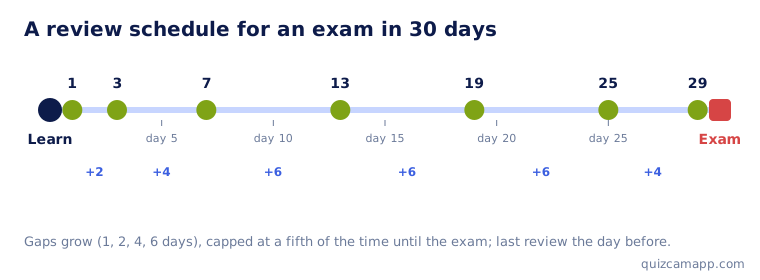
There is no single correct set of numbers, but there is a useful rule of thumb: the further away the exam, the bigger the gaps should be. If the test is in a week, reviewing on days 1, 3 and 6 fits. If it is in three months, days 1, 7, 21 and 60 makes far more sense than five reviews crammed into the first week and nothing afterward.
The second rule is that intervals should grow, not stay flat. Reviewing every three days forever wastes effort on material that is already solid. Doubling the gap after each review you got right (1, 2, 4, 8, 16 days) keeps the difficulty roughly constant while the total number of reviews drops.
Use this chart
Free to use with a link back. Embed code:
The third rule is the one students skip: a wrong answer resets the clock. If you blank on something at the seven-day review, it goes back to a short interval. Spacing only helps when the review actually succeeds, and material you have just failed to recall is material you have not learned yet.
Spaced repetition compared to other methods
- Spaced repetition vs. cramming. Cramming is massed practice: all the study time in one block. It can carry you through tomorrow's test and very little after that. Spacing uses the same total hours spread over days, which is why it costs nothing extra. See cramming vs. spaced study for the full comparison.
- Spaced repetition vs. active recall. Not alternatives. Spacing is a schedule, active recall is an activity. Re-reading on a spaced schedule is better than cramming, but quizzing on a spaced schedule is better than both.
- Spaced repetition vs. flashcards. Flashcards are a format, not a schedule. A deck you flip through in one sitting is massed practice with cards. The spacing comes from when you see each card again.
- Spaced repetition vs. interleaving. Interleaving is about mixing topics within a session, spacing is about distributing sessions across days. They stack well: a spaced review that mixes subjects is harder and more useful than one that does not.
What a spaced repetition app actually does
Software turns the schedule into bookkeeping you no longer have to do. The principle is the same in every one of these tools: each item carries a due date, a correct answer pushes that date further out, a wrong answer pulls it back in. The multipliers differ between apps, the idea does not. What you buy is that you never have to decide what to review today, because the queue has already decided.
The cost is setup. A deck has to exist before it can be scheduled, and writing cards for a whole semester is where most students quietly give up. That is the trade-off behind the usual comparison with Anki: a strong algorithm, on top of material you have to produce yourself.
Quizcam starts from material you already have. Photograph a page of notes, import a PDF or paste text, and the questions are written for you; a long script is worked through in rounds rather than reduced to six questions. From then on the daily review runs the schedule: questions you got wrong come back sooner, questions you nailed come back later, and different subjects are mixed on purpose. Tell the app your exam date and the review is built backwards from it. Reviewing quizzes you already made is free and stays free, so keeping a spaced schedule running costs nothing.
Combine spacing with active recall
Spacing tells you when to study. Active recall tells you how to study. Using both together is the most effective study strategy supported by research.
Re-reading your notes on a schedule is better than cramming. But quizzing yourself on a schedule is better still. When you combine spaced repetition with active recall, you're reviewing at the optimal time and using the optimal method. Each spaced quiz forces your brain to retrieve information right when it's starting to fade, which strengthens the memory far more than a passive review would.
This combination is exactly what Quizcam is built around. You turn a page of notes into a quiz once, and the daily review brings it back on a spaced schedule, so every session gives you the spacing effect and the testing effect at the same time. No deck to build, no review dates to map out by hand.
Quiz yourself on schedule
Photograph your notes once. From there the daily review handles the intervals: wrong answers return sooner, correct ones later, all of it timed against the exam date you set. Three quizzes a month are free and reviewing the ones you already made stays free, so the schedule keeps running either way.
Try Quizcam freeOr play five sample questions in your browser first, no app needed.
Frequently asked questions
What is spaced repetition?
Spaced repetition is a study method where you review material at increasing intervals over time rather than all at once. Each review comes just as you are about to forget, which strengthens long-term memory far more efficiently than massed practice.
Does spaced repetition actually work?
Yes. The spacing effect is one of the most reliable findings in memory research, dating back to Hermann Ebbinghaus in the 1880s. Spreading the same total study time across several sessions consistently produces better long-term retention than cramming it into one.
What is a good spaced repetition schedule?
A common approach is to review material at expanding intervals, for example after 1 day, then 3 days, then 7 days, then 14 days. The exact numbers matter less than the principle: leave enough of a gap that recall takes real effort.
How is spaced repetition different from active recall?
Active recall is about how you study, testing yourself instead of re-reading. Spaced repetition is about when you study, spreading reviews over time. They work best together: quiz yourself on a spaced schedule.
What happens if I get an answer wrong during a review?
The interval resets to something short. Spacing only pays off when the recall attempt succeeds, so material you have just failed on goes back to the front of the queue rather than waiting another two weeks.
Can I use spaced repetition without flashcards?
Yes. Flashcards are one format among several. Practice questions, past exam papers, a blank-page brain dump or a quiz generated from your own notes all work, as long as you attempt the answer from memory and come back to the same material on a growing schedule.
How much time does spaced repetition take per day?
Less than cramming, because you are spending the same total hours differently. Ten to twenty minutes of review a day through the term is typically enough to make the week before an exam a matter of checking rather than learning.
Does Quizcam do spaced repetition?
Yes. Its daily review resurfaces questions you got wrong sooner and ones you answered correctly later, mixes subjects on purpose, and schedules everything backwards from the exam date you enter. Reviewing quizzes you already created is free with no limit.