Definition
Active recall is a study technique in which you try to produce information from memory, with your notes closed, instead of reviewing it in front of you. The effort of searching for the answer is what strengthens the memory, which is why quizzing beats re-reading even when the quiz gives you no feedback.
It is the same idea researchers call retrieval practice, and the finding that it improves retention is the testing effect. Active recall decides how you study. Spaced repetition decides when.
How active recall works
Here's what most students do: they open their notes, read through them, maybe highlight a few lines, and close the laptop feeling like they studied. The problem is that none of that actually builds memory. You're recognizing information, not recalling it. And recognition won't help you on an exam where you need to produce answers from scratch.
Active recall flips this around. Instead of looking at your notes and thinking "yeah, I know this," you close your notes and try to answer a question about the material. When you force your brain to search for an answer, something specific happens: the neural pathway to that memory gets stronger. Every successful retrieval makes the next retrieval a little easier.
Think of it like this. If someone gives you directions to a restaurant, you might remember them for the drive there. But if you have to find the restaurant without directions the next day, you'll remember the route much longer. The effort of finding the route yourself is what makes it stick. Active recall works the same way. The struggle to pull an answer from memory is the thing that builds the memory.
Passive review (re-reading, highlighting, copying notes) feels productive because you're spending time with the material. But your brain isn't doing the hard work of retrieval. It's just absorbing words on a page. That feeling of "I've seen this before" tricks you into thinking you know it. Psychologists call this the fluency illusion, and it's the reason so many students feel prepared going into an exam and then blank on the questions.
What the research says
The evidence for active recall is overwhelming. It's not a fringe theory or a study hack from TikTok. It's one of the most well-supported findings in cognitive psychology.
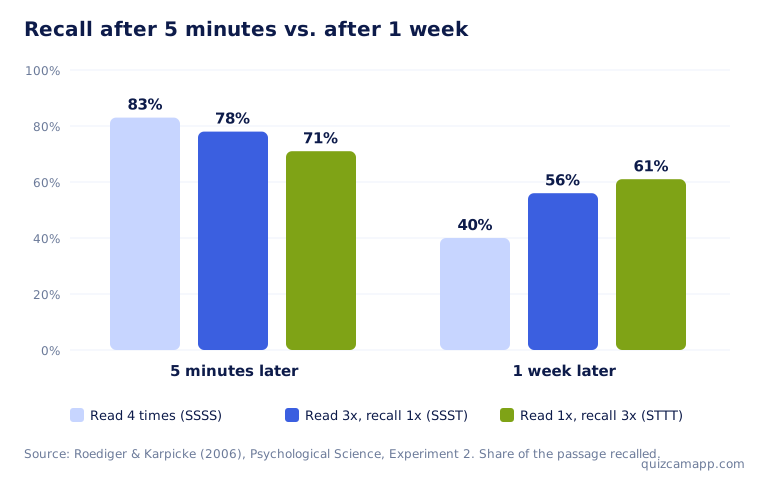
The most cited study comes from Roediger and Karpicke, published in 2006 in Psychological Science. They had students read a short passage. One group re-read the passage four times. Another group read it once and then took three recall tests (without feedback). When both groups were tested a week later, the results were stark: the testing group remembered 61% of the material, while the re-reading group remembered only 40%, although the re-readers had done better on a test five minutes after studying.
Use this chart
Free to use with a link back. Embed code:
Let that sink in. The students who spent three quarters of their time testing themselves remembered about half as much again as those who spent all of their time reading. Less reading, more testing, better results.
In 2011, Karpicke and Blunt took this further. They compared retrieval practice against concept mapping, which is a popular study technique where you draw diagrams connecting ideas. Students who practiced retrieval outperformed the concept mappers by a significant margin on a final test, even when the test required drawing inferences and making connections between ideas. Retrieval practice didn't just help with memorizing facts. It helped with understanding too.
A 2014 meta-analysis by Rowland, published in Psychological Bulletin, pooled the research on the testing effect. The conclusion was clear: testing yourself on material produces better long-term retention than restudying it, and this holds true across different types of material, different age groups, and different testing formats.
How to practice active recall
You don't need any special tools or techniques to start using active recall. Here are four approaches.
The blank page method is one of the simplest. After a lecture or study session, close all your notes. Open a blank page and write down everything you can remember. Don't worry about getting it perfect; the point is the effort of trying to remember. After you've written everything you can, open your notes and check what you missed. Focus your next study session on those gaps.
End-of-chapter practice questions work better than most students realize. If your textbook has them, actually do them. Don't just read the questions and think about the answers in your head. Write out full answers, then check them. If your textbook doesn't have questions, search for practice problems online for your specific course or topic.
Teaching material to someone else forces you to organize your thinking in a way that reading never does. Find a friend, a family member, or even just an empty chair, and explain the material out loud. When you get stuck and can't explain something, that's where your knowledge has gaps. This is sometimes called the Feynman technique, and it's one of the most effective forms of active recall for that reason.
Flashcards work well for active recall, but only if you use them correctly. Look at the question side and try to produce the full answer before flipping. If you immediately flip the card and read the answer, you're doing recognition, not recall. The pause where you struggle to remember is where the learning happens.
The common thread is effort. Active recall should feel a bit uncomfortable. If it feels easy, you're probably just recognizing information rather than truly retrieving it. That discomfort is your brain building stronger memory traces.
One caveat about multiple choice: it is real active recall, but it is the easy version, because the correct answer is somewhere on the screen. Use it to get started, to cover a lot of material quickly, or when free recall is still too hard, and try to answer before you read the options. Then move toward formats that make you produce the answer yourself.
Quizcam makes active recall automatic
Photograph a page of notes, including handwritten ones, import a PDF or paste text, and Quizcam writes the multiple-choice questions. You get recall practice from your own material without building a card deck: a hint when you are stuck, a short explanation after every answer, and a daily review that brings the questions back before your exam. Three quizzes a month are free and reviewing the ones you already made stays free.
Try Quizcam freeOr play five sample questions in your browser first, no app needed.
Frequently asked questions
What is active recall?
Active recall is a study technique where you test yourself on material instead of passively re-reading it. By forcing your brain to retrieve information from memory, you strengthen the neural pathways associated with that knowledge, making it easier to remember during exams.
Is active recall better than re-reading notes?
Yes. Research by Roediger and Karpicke (2006) showed that students who practiced recalling a passage remembered 61% of it a week later, compared to 40% for students who re-read it. Active recall consistently outperforms passive review methods across dozens of studies.
How do I practice active recall?
Close your notes and try to write down everything you remember. Use practice questions or flashcards to quiz yourself. Explain the material out loud to someone else. The key is to attempt retrieval before looking at the answer.
Does active recall work with multiple-choice questions?
Yes, though it is the gentler version, because the correct answer is on the screen and acts as a cue. Try to answer before reading the options, and treat multiple choice as a way into a topic rather than the last step before an exam.
How long should an active recall session be?
Ten to twenty minutes is plenty. Retrieval is tiring in a way that reading is not, so short sessions repeated across days beat one long one. Pairing it with the Pomodoro technique is a simple way to keep the sessions honest.