Definition
Retrieval practice is the study technique of deliberately recalling information from memory, with your notes closed, in order to strengthen that memory. Every successful retrieval makes the same information easier to find the next time, which is why testing yourself beats reading the material again.
In practice it means answering questions instead of reviewing answers: a blank-page brain dump, end-of-chapter problems, flashcards, or a quiz built from your own notes. Researchers describe the same effect from the other side and call it the testing effect.
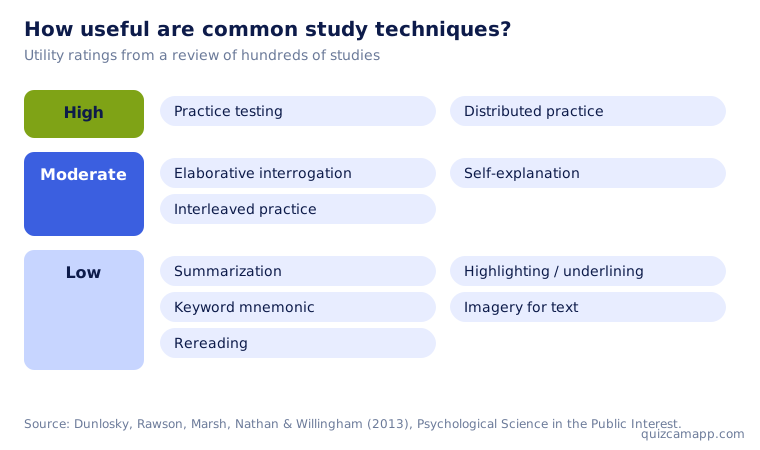
Use this chart
Free to use with a link back. Embed code:
Retrieval vs. recognition
There's a difference between recognizing something and retrieving it, and that difference matters a lot for exam performance.
Recognition is what happens when you look at your notes and think "I know this." The information is right in front of you, and your brain just confirms that it's familiar. It's easy and it feels good. You close your notebook confident that you've studied well.
Retrieval is what happens when someone asks you a question and you have to produce the answer from scratch. Nothing is in front of you. You have to search through your memory, find the right information, and bring it to the surface. It's harder and it often feels uncomfortable, especially when you can't quite get to the answer.
Here's why this matters: exams test retrieval. When you sit down to an exam, your notes aren't in front of you. You have to produce answers from memory. If you've been studying by re-reading (practicing recognition), you've been training a skill that won't be tested. If you've been practicing retrieval, you've been training the exact skill the exam requires.
This is why so many students feel blindsided by exams. They spent hours with their notes and felt confident, but the exam requires a completely different cognitive skill than the one they practiced. It's like preparing for a swimming race by watching videos of swimmers. You know what good swimming looks like, but you can't do it.
Why pulling from memory strengthens it
Think of a memory like a path through a dense forest. The first time you walk the path, it's barely visible. Branches are in the way, the ground is uneven, and you might lose the path entirely if you look away. But every time you walk that same path, it gets a little more worn. The ground packs down, the branches get pushed aside, and eventually it becomes a clear trail you can find without thinking.
Now imagine instead of walking the path, you just look at a map of it. You can see exactly where the path goes. You know every turn. But the actual path in the forest hasn't changed at all. It's still overgrown. The next time you try to walk it without the map, you'll have just as much trouble as the first time.
That's the difference between retrieval and re-reading. Re-reading is looking at the map. Retrieval is walking the path. Only one of them actually clears the trail.
At a neurological level, retrieval practice strengthens the connections between neurons that hold a particular memory. When you actively search for information and successfully find it, the synaptic connections involved in storing that information get reinforced. This process, called memory reconsolidation, makes the memory more stable and more accessible next time.
The effort involved matters too. Psychologists Robert Bjork and Elizabeth Bjork introduced the concept of "desirable difficulties." When retrieval feels hard, when you have to struggle to find the answer, that difficulty is actually a signal that meaningful learning is happening. Easy retrieval (like re-reading something you just read two minutes ago) produces less strengthening. The harder you have to work to retrieve something, the stronger the memory becomes afterward.
Practical retrieval practice strategies
You don't need anything fancy to practice retrieval. Here are four methods that work, ranked from simplest to most involved:
- The blank page method. This is the easiest way to start. After a lecture or study session, close everything. Grab a blank sheet of paper and write down everything you can remember from what you just learned. Don't organize it or worry about getting things in the right order. Just dump everything you can recall onto the page. When you run out of things to write, open your notes and see what you missed. Those missed items are your study priorities for next time. Agarwal and Bain, who run the research site RetrievalPractice.org, consider this the single most effective low-effort study technique available.
- Practice questions. Find or write questions about the material and answer them without looking at your notes. This is more structured than the blank page method, and it forces you to retrieve specific information rather than whatever comes to mind first. If your textbook has review questions at the end of each chapter, use them. If your professor posts old exams, work through them. The specific format of the questions (multiple choice, short answer, essay) matters less than the act of trying to answer them from memory.
- Self-quizzing. After reading a chapter or section, stop and ask yourself questions about what you just read. "What were the three causes of X?" "How does Y process work?" "What's the difference between A and B?" Try to answer each question in your head or out loud before moving on. If you can't answer, go back and read just that part again, then try to answer without looking. This takes a bit more discipline than the other methods because you have to generate the questions yourself, but it's something you can do anywhere without any materials.
- Teaching. Explain the material out loud as if you're teaching it to someone who knows nothing about the topic. This is sometimes called the Feynman technique, named after physicist Richard Feynman who was famous for his ability to explain complex ideas simply. When you try to teach something, you're forced to retrieve the information, organize it into a logical sequence, and identify parts you don't understand well enough to explain. If you stumble or get vague, that's a clear signal about where your understanding breaks down.
One thing to keep in mind: retrieval practice is supposed to feel difficult. If you can easily recall everything, you're either not challenging yourself enough or you've already mastered the material. The struggle is the point. When you're straining to remember something and it finally comes to you, that moment of effortful retrieval is exactly when the memory is getting stronger.
Retrieval practice in course and homework questions
Psychology and study-skills courses ask about retrieval practice in a handful of standard phrasings. Here is what each one is getting at.
- "Retrieval practice is a way to work with your stored memories to ______" The expected completion is about strengthening them: making stored memories more durable and easier to recall later. The point of the sentence is that retrieval is not a neutral readout. Using a memory changes it, and it changes it in the direction of being easier to reach next time.
- "Retrieval practice is most effective when ______" When you attempt the answer before checking it, when the attempts are spread out over days rather than repeated in one sitting, and when you find out afterward what you got wrong.
- "What is a retrieval cue?" Anything that helps you locate a stored memory: a question, a keyword, a multiple-choice option, a place. Cues vary in strength. A blank page is a weak cue and a list of options is a strong one, and the weaker the cue you can still succeed with, the more the retrieval strengthens the memory.
- "Is retrieval practice the same as rehearsal?" No. Rehearsal means repeating something to hold it in working memory, like saying a phone number over and over. Nothing has to be found again, so nothing gets strengthened for the long term. Retrieval means the information has left your attention and you go looking for it.
- "Retrieval practice vs. the testing effect" Retrieval practice is the technique you perform. The testing effect is the research finding that the technique improves long-term retention. Many papers use the two terms interchangeably.
Quizcam automates retrieval practice
Instead of writing questions from your notes by hand, Quizcam generates them. Photograph a page, import a PDF or paste text, and you are retrieving from your own material with no setup. Every answer comes back with a one or two sentence explanation, and a hint is there for the questions you get stuck on. Three quizzes a month are free, and reviewing quizzes you already made stays free.
Try Quizcam freeOr play five sample questions in your browser first, no app needed.
Frequently asked questions
What is retrieval practice?
Retrieval practice is the act of deliberately recalling information from memory as a study strategy, instead of reviewing it passively. Pulling an answer from memory strengthens that memory and makes it easier to recall later.
Is retrieval practice the same as the testing effect?
They are closely related. Retrieval practice is the technique of actively recalling material; the testing effect is the research finding that this technique improves retention. In practice the terms are often used interchangeably.
How do I do retrieval practice?
Close your notes and try to reproduce the material from memory: answer practice questions, write a brain dump, or explain the topic aloud. Then check your notes to find and fix any gaps.
Why does retrieval practice work better than re-reading?
Re-reading creates a feeling of familiarity that is easily mistaken for knowledge. Retrieval practice forces your brain to do the hard work of reconstruction, which is what actually builds durable memory.
What is a retrieval cue?
A retrieval cue is anything that helps you locate a stored memory: a question, a keyword, a multiple-choice option, or the room you first learned something in. Weak cues make retrieval harder and therefore more useful, which is why a blank page beats a list of options once you can handle it.
How often should I do retrieval practice?
Short and often beats long and rare. A few minutes after each lecture, then again after one day, three days, seven days and fourteen days, covers most courses. That schedule is spaced repetition, and combining it with retrieval is the strongest pairing in the research.