Definition
Interleaving is a practice strategy in which you mix different topics or problem types within one study session, instead of finishing all of one type before starting the next. The opposite is blocking: ten problems of the same kind in a row.
Interleaving makes practice feel slower and more error-prone, and produces better results on the test. The reason is that it forces you to work out which method a problem needs, which is the part blocking lets you skip. It pairs naturally with spaced repetition, which mixes across days rather than within a session.
Blocked vs. interleaved practice
Most students study in blocks. You sit down, open Chapter 3, work through all the material, do the practice problems at the end, and then move on to Chapter 4. This is called blocked practice, and it feels like the natural way to study. You get into a rhythm. Each problem feels a little easier than the last because you're using the same approach over and over.
Interleaved practice flips that. Instead of doing all the Chapter 3 problems, then all the Chapter 4 problems, you mix them together. Problem 1 from Chapter 3, then problem 1 from Chapter 4, then back to Chapter 3, then Chapter 5. It's messy. It feels confusing. You'll be slower, and you'll make more mistakes during practice.
But here's the thing: the goal of studying isn't to feel smooth during practice. It's to perform well on the test. And on the test, problems from different chapters are all jumbled together. Nobody labels them for you. Interleaving trains you for that reality.
What the research shows
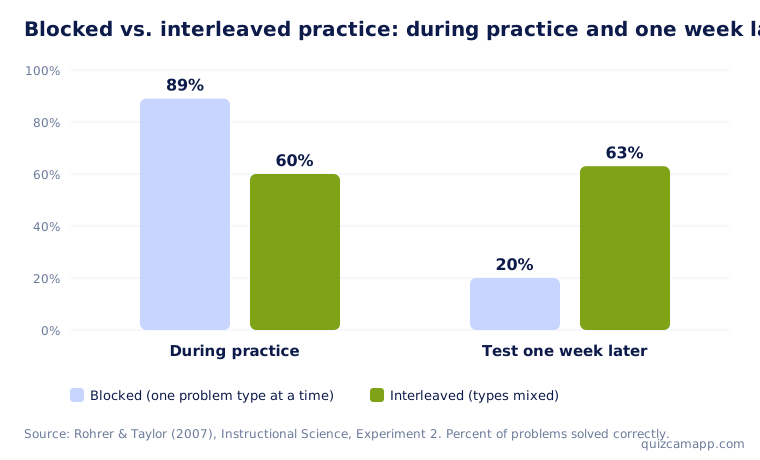
In 2007, Rohrer and Taylor ran an experiment with college students learning math. One group practiced problems in blocks (all problems of one type, then all of another type). The other group practiced the same problems interleaved (types mixed randomly). During practice, the blocked group performed better. They were faster and more accurate. But on a test a week later, the interleaved group got 63% of the problems right and the blocked group only 20%.
Use this chart
Free to use with a link back. Embed code:
This pattern shows up everywhere researchers have looked. In a study on learning to identify paintings by different artists, interleaved practice led to better identification on new paintings than blocked practice. Medical students who studied different types of skin conditions in an interleaved fashion diagnosed new cases more accurately than those who studied one condition at a time. Sports scientists have found the same effect: baseball players who practice hitting different pitch types in random order perform better in games than those who practice one pitch type at a time.
The size of the effect varies, but the direction is consistent. Blocked practice feels better during the session. Interleaved practice produces better results afterward.
Why it feels harder but works better
When you do ten problems in a row that all use the same formula, you stop thinking about which formula to use after the first couple. Your brain goes on autopilot. You're getting practice with the calculation, but you're not practicing the most important skill: figuring out which approach to use in the first place.
On a real exam, you don't know which chapter a question is from. You have to look at the problem, figure out what type it is, decide which method applies, and then execute. Interleaving forces you to do that sorting work during practice. Every time you switch to a different problem type, your brain has to ask: "Wait, what am I dealing with here? What's the right approach?"
This is a form of what researchers call "desirable difficulty." It slows you down during practice, but it builds a deeper understanding of when and why to use each strategy. You're not just learning how to solve problems. You're learning how to recognize which kind of problem you're looking at.
There's another benefit too. When you study two related concepts back to back (like, say, mitosis and meiosis), the contrast helps you see the differences more clearly. In blocked practice, you might study mitosis for an hour and feel like you understand it. Then you study meiosis the next day and feel like you understand that too. But you never directly compared them, so on the exam when a question asks about the differences, you're less prepared.
How to interleave your studying
You don't need a complicated system. Here are some concrete ways to start.
If you have three subjects to study, don't spend the first hour on biology, the second on chemistry, and the third on history. Instead, spend 20-30 minutes on biology, switch to chemistry for 20-30 minutes, then history, and cycle back. Each time you return to a subject, you'll have to reload the context, which takes effort. That effort is the learning.
When doing practice problems, mix them up. If your math textbook has 20 problems at the end of each chapter, don't do them chapter by chapter. Pick 5 from Chapter 3, 5 from Chapter 4, 5 from Chapter 5, and shuffle them. If you're using a problem set, cover the chapter labels so you don't know which type each problem is.
For fact-based subjects like history or biology, alternate between topics within a study session. Spend 15 minutes on the causes of WWI, then 15 minutes on cell division, then back to WWI. When you return to WWI the second time, you'll have to recall where you left off, and that retrieval effort strengthens the memory.
One warning: interleaving works best when the topics are somewhat related or when you're comparing different approaches. Switching between completely unrelated subjects (like French vocabulary and calculus) is just multitasking, which isn't the same thing. The power comes from having to discriminate between similar concepts or methods.
Expect it to feel worse at first. You'll feel like you're not making progress because you keep switching gears. Trust the research. The confusion you feel during interleaved practice is your brain doing the hard work that leads to better performance when it counts.
If you use an app for review, check whether it mixes for you. Most review queues run subject by subject, which is blocking with extra steps. Quizcam's daily review pulls from everything you have made and mixes the subjects on purpose, so a round can jump from anatomy to statistics the way an exam paper does. It also spaces the questions: the ones you got wrong come back sooner, the ones you nailed come back later.
Quiz yourself across topics
Photograph notes from several subjects or import the PDFs, and Quizcam's daily review mixes the questions across all of them instead of working through one subject at a time. Three quizzes a month are free and reviewing the ones you already made stays free.
Try Quizcam freeOr play five sample questions in your browser first, no app needed.
Frequently asked questions
What is interleaving in studying?
Interleaving is a study method where you mix different topics or problem types within one session, instead of practicing one type to completion before moving on, which is known as blocking.
Does interleaving improve learning?
Yes. Research shows that although interleaving feels harder and slower in the moment, it produces better long-term retention and a stronger ability to tell related concepts apart than blocked practice.
Why does interleaving feel harder than blocking?
Interleaving constantly forces your brain to retrieve the right approach for each new problem, rather than repeating one approach on autopilot. That extra effort feels uncomfortable but is exactly what builds durable, flexible knowledge.
How do I use interleaving when I study?
Mix related topics in a single session, for example by alternating between different question types or chapters rather than finishing one entirely first. It works well combined with self-testing.
Is interleaving the same as multitasking?
No. Multitasking means splitting attention between two things at once. Interleaving means giving one problem your full attention, then switching to a different kind of problem. The benefit comes from having to identify which approach each problem needs, which only works if the topics are related enough to be confused.
When is blocked practice the better choice?
When you are learning a method for the very first time. You need a few repetitions to get the procedure working at all before mixing makes sense. Block long enough to be able to do it, then interleave to learn when to do it.